 Needle
You’ve already
tried everything
else.
Acupuncture doesn’t mask pain — it interrupts the nervous system’s habit of producing it.
Does it actually hurt?
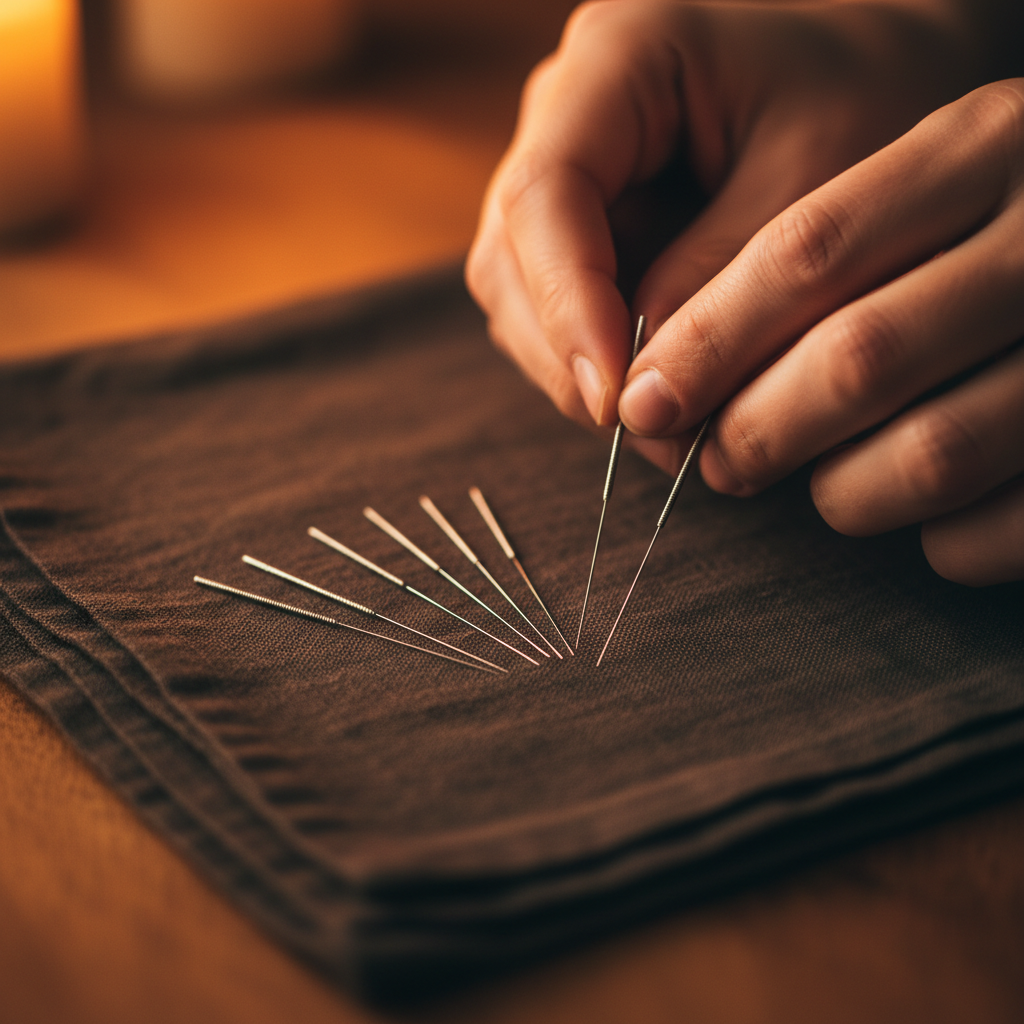
Most people expect a needle to feel like a needle. It doesn't. Acupuncture uses filiform needles — about the width of a human hair — and the sensation, when you feel anything at all, is described as a dull ache, a warmth, or a brief electric twitch. That twitch has a name: de qi. It's the signal that the needle has reached the fascial layer where the nerve endings cluster. In a 2017 study published in the Journal of Pain, 78% of participants rated the procedure as "comfortable" or "slightly uncomfortable" — on par with having your blood pressure taken. The remaining 22% reported mild pinching at insertion that resolved within seconds. First-time patients are often most surprised by what they don't feel.
The de qi sensation activates A-delta nerve fibers, which carry inhibitory signals to the spinal cord — the same pathway targeted by TENS therapy.
How many sessions before I feel something?
It depends on what you're treating and how long it's been there. Acute conditions — a stiff neck from last week, pregnancy nausea — often respond within two to three sessions. Chronic patterns that have been building for years, like a frozen shoulder or persistent lower back tension, typically need six to eight sessions before the change becomes stable. The first session is mostly diagnostic. Your body tells us things your history form can't: which points are reactive, how your tissue responds, where the holding patterns live. Many patients notice better sleep before they notice pain relief — that's the nervous system downregulating, which is usually the first sign the work is landing.
A 2012 meta-analysis in the Archives of Internal Medicine — pooling data from 17,922 patients — found acupuncture significantly superior to both sham and no-acupuncture controls for chronic pain.
Is there actually evidence this works?
Yes — and it's more rigorous than most people expect. The challenge with acupuncture research is the placebo problem: you can't give someone a sugar pill version of a needle. Researchers use "sham acupuncture" — needles placed at non-therapeutic points — as the control. What the best studies consistently show is that both real and sham acupuncture outperform no treatment, and real acupuncture outperforms sham for specific conditions. The National Institutes of Health includes acupuncture in its clinical guidelines for chronic low back pain, osteoarthritis, and chemotherapy-induced nausea. The World Health Organization lists 28 conditions with "proven" evidence for acupuncture treatment. This isn't fringe medicine. It's a 2,500-year-old clinical practice that's survived contact with the randomized controlled trial.
The NIH's 2017 NCCIH report concluded: "Acupuncture is effective for several pain conditions and has a favorable safety profile."
Ready when you are
Your first session is a conversation as much as a treatment.
Three kinds of people.
One underlying mechanism.
Your shoulders have been up near your ears since 2019.
Sustained forward head posture compresses the cervical facet joints and chronically fires the levator scapulae. Acupuncture releases the trigger points in the upper trapezius and restores range of motion that stretching alone can't reach — because stretching a muscle under neurological guard only makes it guard harder.
Typical result: measurable ROM improvement within 3 sessions.
Nausea that no one warned you would be this relentless.
Pericardium 6 — a point on the inner wrist — has the strongest evidence base of any acupuncture point. Multiple Cochrane reviews confirm its effect on nausea via the vagus nerve. It's safe in all trimesters, requires no medication, and works within minutes for most patients.
PC6 is now recommended by many OBs as a first-line nausea intervention.
The knee that whispers on downhills.
Patellofemoral syndrome and IT band syndrome both involve the lateral fascial chain — a continuous sheet of connective tissue running from the hip to the ankle. Needling the Gallbladder meridian points along this chain releases tension that foam rolling addresses only superficially. Most runners return to full training within four to six weeks.
Gallbladder 34 (Yang Ling Quan) is the influential point for all sinew and tendon.
When you've forgotten what it feels like not to hurt.
Long-term pain rewires the brain — literally. The somatosensory cortex reorganizes around the pain signal, which is why chronic pain often persists even after the original injury heals. Acupuncture interrupts this central sensitization by activating endogenous opioid pathways. fMRI studies show measurable changes in brain activity after a single session.
Beta-endorphin release following needling has been confirmed in cerebrospinal fluid analysis.
Dr. Maya Chen, L.Ac.
Master’s in Traditional Chinese Medicine, Pacific College of Health and Science. Clinical training completed at Zhejiang Provincial Hospital of TCM, Hangzhou. Eleven years in private practice, with a focus on musculoskeletal pain, reproductive health, and nervous system regulation.
I trained in a hospital setting where acupuncture was practiced alongside oncology, orthopedics, and obstetrics — not as an alternative to medicine, but as a clinical tool within it. That’s still how I think about it.
Ready when you are